
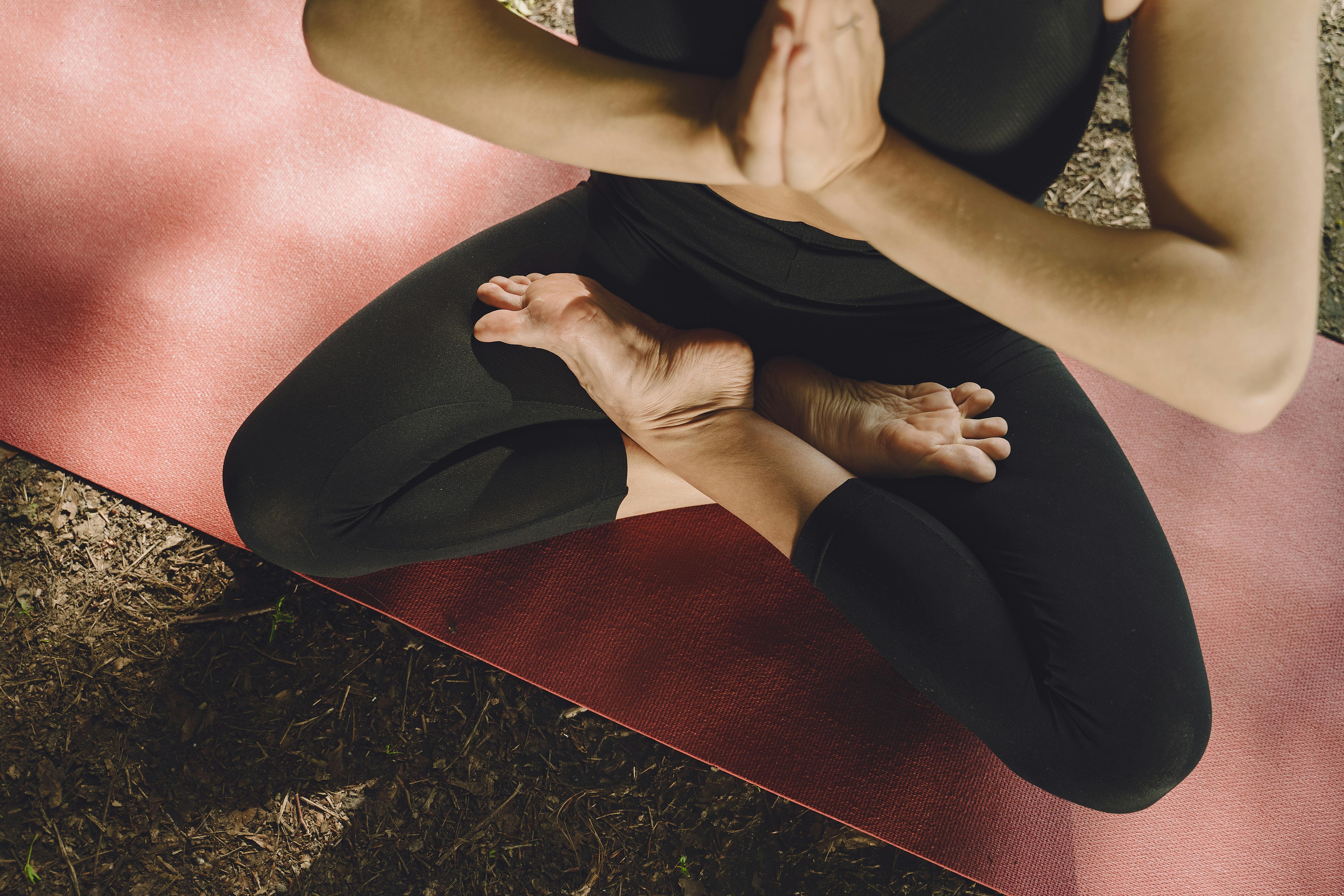
Standing on one leg looks like a static position and is not. It is a continuous sequence of small corrections, and what improves with practice is the correcting system rather than the posture.
Standing is an unstable equilibrium
The human body carries most of its mass high above a small base of support, an arrangement that is inherently unstable.
Balance is maintained by keeping the centre of mass over that base, and any drift must be detected and corrected before it grows.
Removing one foot shrinks the base drastically, which is why single-leg standing is demanding: the same drift now has far less margin.
Three sensory systems report position
Vision supplies information about the position of the head relative to the surroundings.
The vestibular system in the inner ear detects head acceleration and orientation relative to gravity, independent of what is visible.
Proprioception, from receptors in muscles, tendons and joints, reports joint angles and muscle tension, and gives the body its sense of its own configuration.
The brain weights the inputs and reweights them
These three streams sometimes disagree, so the nervous system weights them according to which is currently most reliable.
Closing the eyes removes vision from the calculation, and balance becomes harder while the remaining systems are reweighted, which is why eyes-closed variants are markedly more difficult.
An unstable surface degrades proprioceptive information the same way, shifting reliance elsewhere. Training under varied conditions is what improves that reweighting.
Corrections happen faster than decisions
Much of the correction is reflexive, handled by loops through the spinal cord and brainstem that operate faster than a conscious response could.
The ankle makes small continuous adjustments for minor drift, and the hip takes over for larger disturbances, with a step as the last resort.
Practice reduces the size of the corrections needed and shortens the delay before they occur, which is what makes a held posture look still.
The trained capacity transfers to ordinary situations
Balance ability declines with age as sensory acuity and reaction speed decrease, and falls are a serious consequence of that decline.
Programmes that challenge balance are a standard component of fall prevention, because the underlying system responds to being loaded.
Practising near a wall or a stable support is sensible, and anyone with dizziness, vertigo or a recent fall should raise it with a clinician rather than train through it.